Dust extraction. Precision cuts. Certified waterproofing systems. Here's what separates a result that lasts from one that fails in three years.
Flooring and tile installation looks straightforward on the surface. But the results that last decades — the showers that never leak, the large-format tile that lays perfectly flat, the hardwood that doesn't cup — come from decisions made before a single tile is set. Substrate preparation. Proper waterproofing systems. Tools that can actually make the cuts the design requires. And a jobsite that doesn't fill a home with respirable silica dust.
These aren't premium extras. They're the baseline. Here's why.
Cutting tile — especially porcelain and stone — releases respirable crystalline silica (RCS). The International Agency for Research on Cancer (IARC) classifies silica dust inhaled from occupational sources as a Group 1 carcinogen: the highest classification, meaning there is sufficient evidence it causes cancer in humans. The disease it causes, silicosis, is irreversible and progressive. There is no cure.
Standard dust masks do not adequately capture particles at the sizes that cause silicosis. The only protection that works is source capture — extracting the dust at the point of cut, before it becomes airborne.
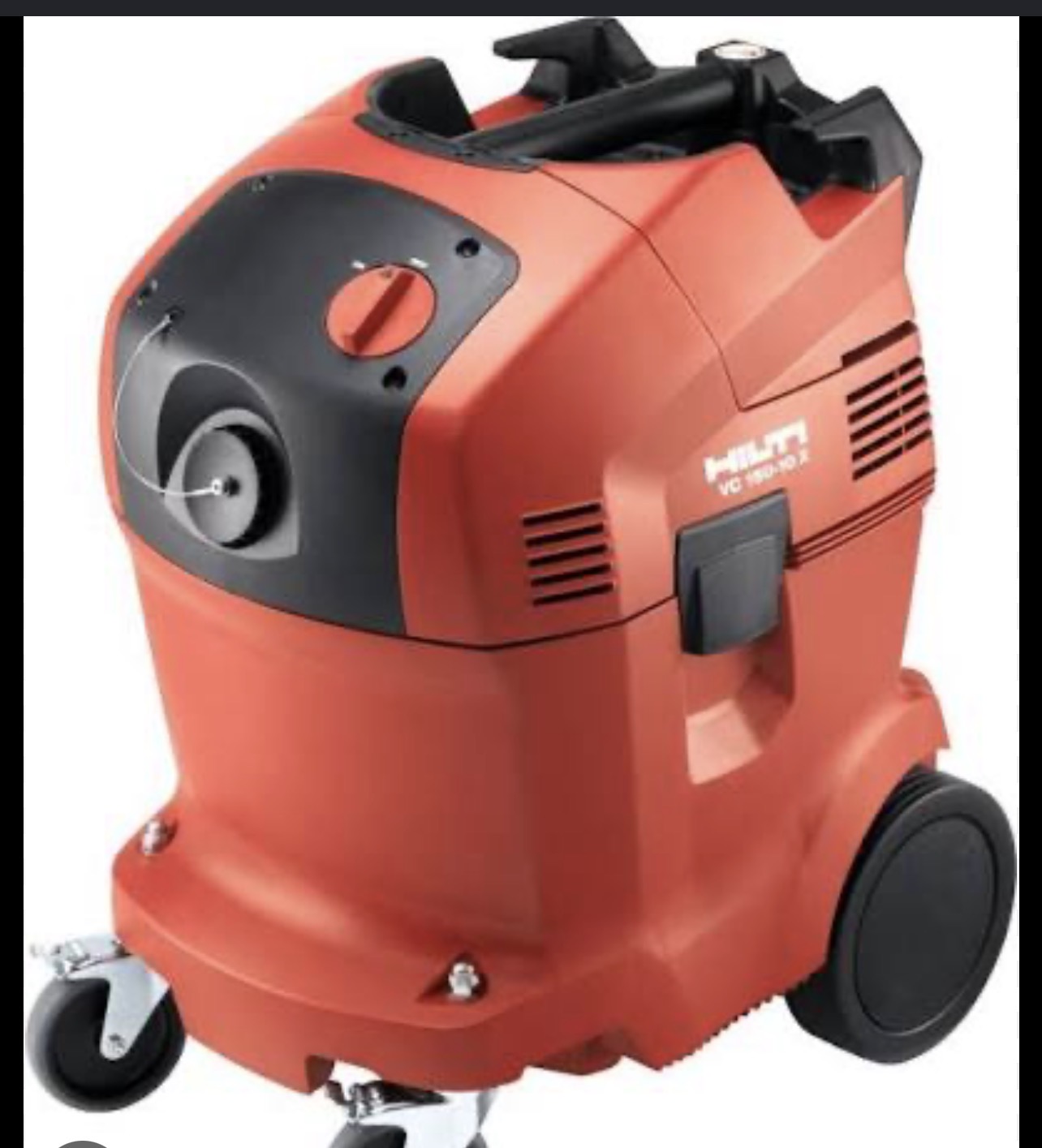
We use the Hilti VC 150-10 X with HEPA Class H filtration. HEPA Class H is the highest filtration grade available — rated to capture 99.995% of particles at 0.3 microns. Silica particles that cause silicosis range from 0.5 to 5 microns. Class H filtration captures them.
This matters for everyone on the job: the installer, the homeowner, and anyone else in the building. It also matters for the home itself — silica dust settles into HVAC systems, cabinet interiors, and every surface in the work area. Proper extraction means a cleaner finish and a healthier home after we leave.
HEPA Class H at a glance
Filtration grade: Class H (highest available)
Capture rate: 99.995% at 0.3 microns
What it captures: silica, mortar, grout, stone dust
Standard we hold: source-capture on every cut, every day
Silica dust lingers in the air for hours after cutting stops. HEPA extraction at the source means it never becomes airborne in your home.
Less dust means less cleanup. Tile dust without extraction coats every surface in the room — and infiltrates HVAC ducts, closets, and adjacent rooms.
On commercial sites in Ontario, silica dust control is legally required under occupational health regulations. We apply the same standard to residential work.
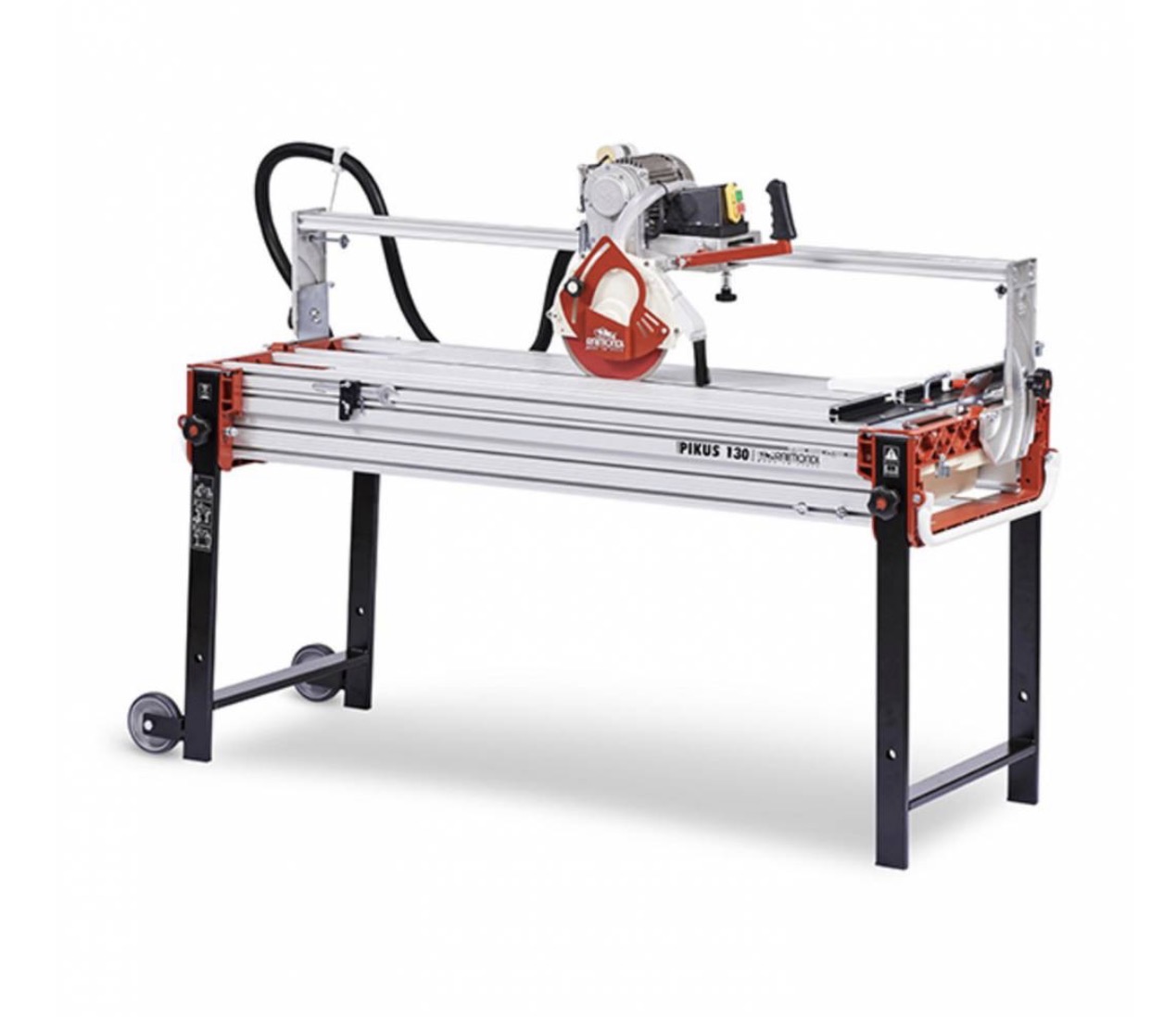
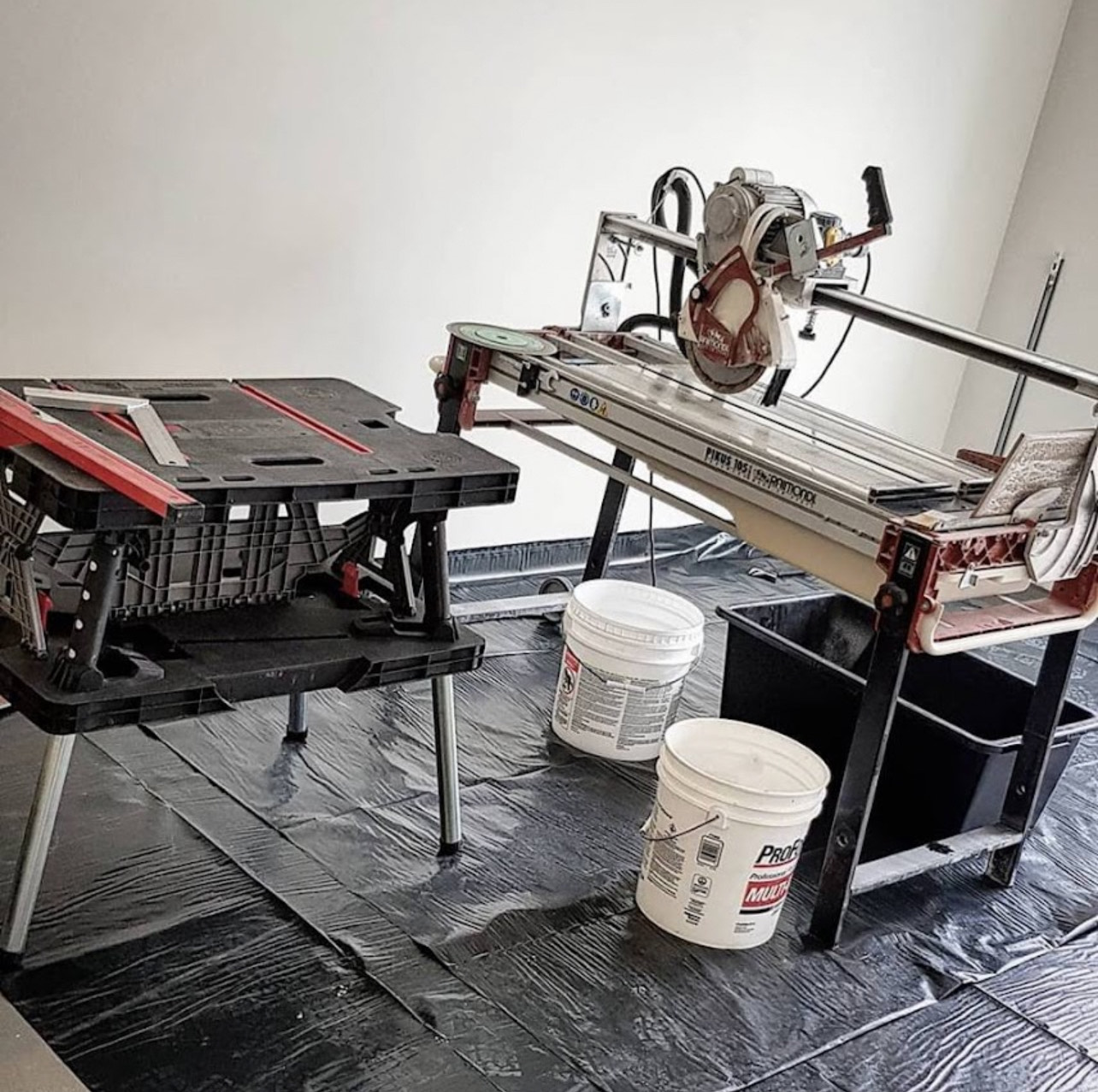
A professional bridge saw — we use the Raimondi PIKUS 130 — costs several thousand dollars, requires transportation, and takes real skill to operate. Most tile contractors use a standard wet saw instead: a rotating table with a fixed blade that handles basic straight cuts fine, but fails the moment a job demands something more precise.
The bridge saw works differently. The tile is fixed flat on the table. The cutting head travels on a rigid overhead rail system. This fixed-rail geometry is what makes the following cuts possible — and makes them clean:
A recessed tile niche requires cutting a precise rectangular opening in a tile panel — not just a straight edge, but an internal cutout. A standard wet saw cannot do this: the rotating tile would kick. The bridge saw's fixed-table geometry holds the tile completely stable while the blade travels across it, making clean internal stop-cuts that produce a perfect opening for the niche shelf.
Where two walls meet at a non-standard angle, or where a tile must wrap around a post or built-in bench, you need a precise L-shaped cut in a single tile. This requires two perpendicular cuts that meet at an interior corner — a shape that cannot be safely made with a rotating wet saw without risk of the tile breaking. The bridge saw handles this cleanly and repeatedly.
A mitered corner — where two tiles meet edge-to-edge at 45°, creating a seamless right angle with no Schluter profile required — is the mark of truly high-end tile work. It makes large-format shower panels look like they were carved from a single slab. This cut requires a tilt-head attachment that only bridge saws carry. The angle must be held precisely across the full length of a tile that may be 60, 90, or 120cm long. There is no practical way to execute this on a standard wet saw.
When a contractor tells you they can achieve the same results with a $300 wet saw that you can get from a $4,000 bridge saw, they're either not doing those cuts — or doing them badly. The difference shows up in your finished walls.
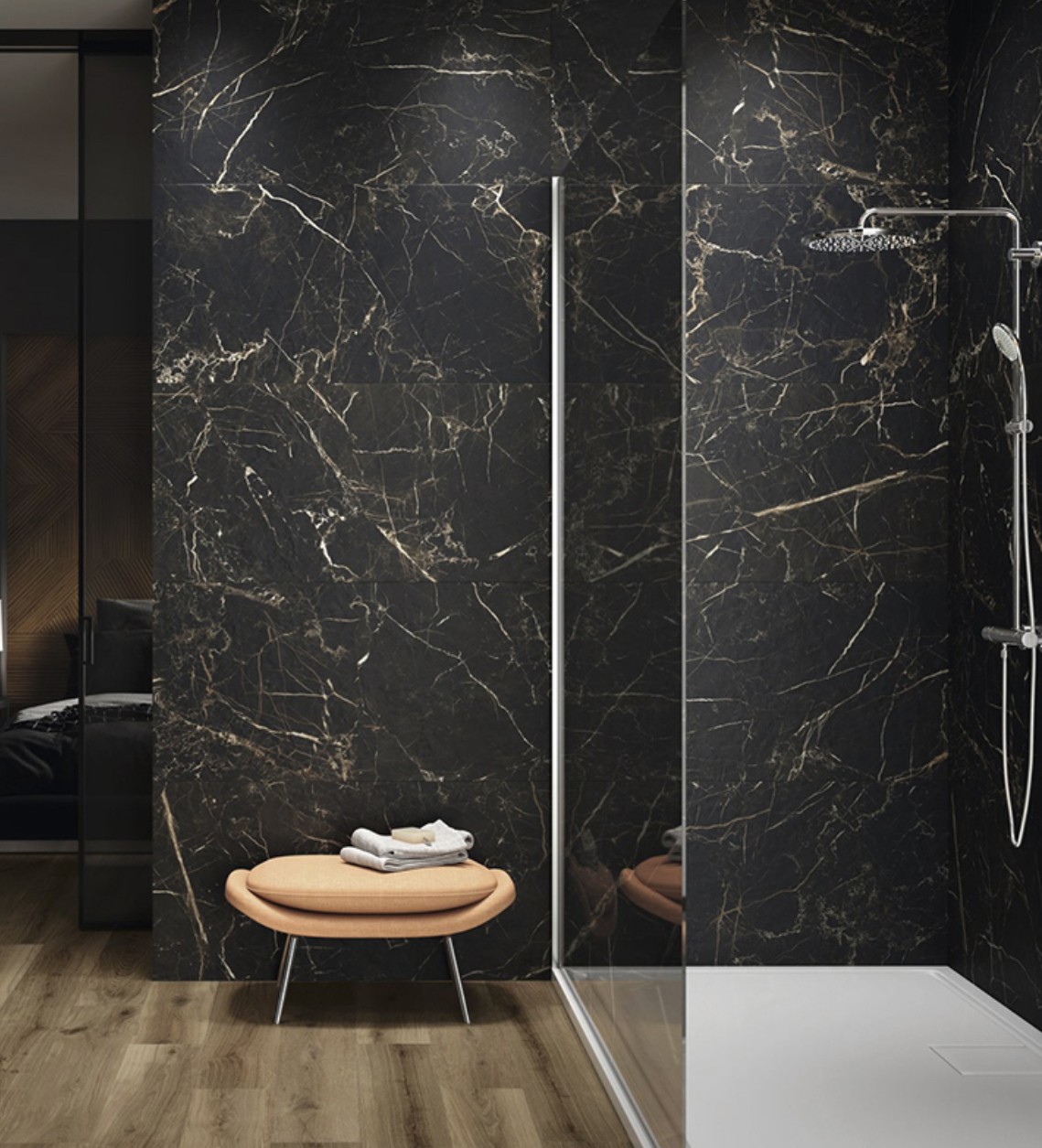
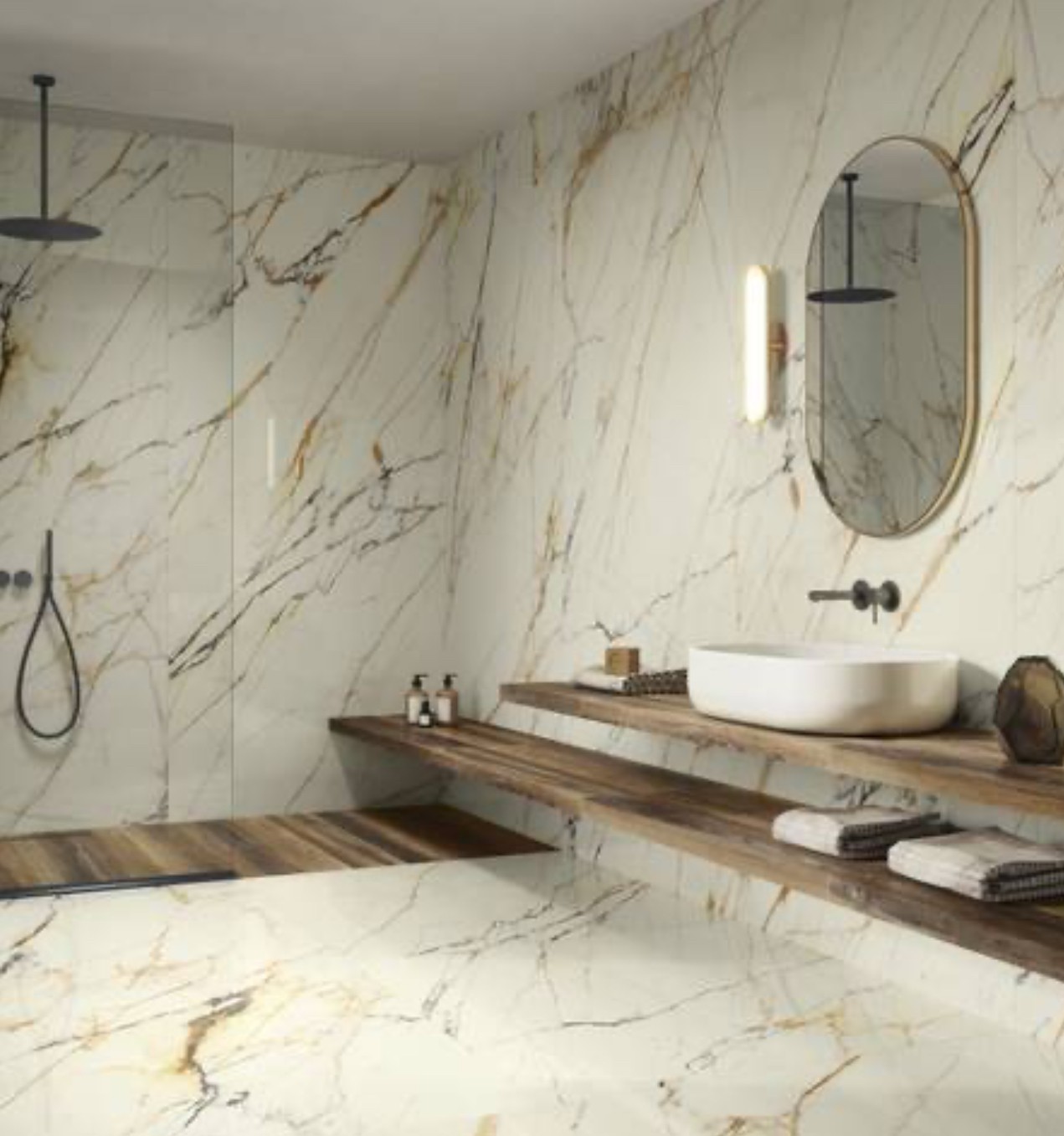
The showers in our gallery — continuous large-format marble-look slabs running floor to ceiling, corners that meet cleanly with no aluminum trim — are only possible because every single edge was cut on the bridge saw. The tiles meet at a perfect 45° mitered join. There are no Schluter profiles hiding bad cuts. There is no grout joint at the corner drawing the eye.
This is the result of owning the right equipment and knowing how to use it.
See the Results in Our GalleryWaterproofing, uncoupling, transition systems
Schluter Systems manufactures the KERDI waterproofing membrane, the DITRA uncoupling membrane, KERDI-BOARD substrate panels, and transition and edge profiles used throughout the tile industry. Schluter Certified means we have completed manufacturer training and testing in the correct installation of these systems.
The most common cause of shower failure isn't bad tile — it's bad waterproofing behind the tile. Water that gets through grout joints (and it always does, eventually) needs to be stopped at the membrane layer, not at the substrate. A Schluter KERDI membrane installed correctly — seams properly lapped and bonded, corners reinforced, penetrations sealed — creates a continuous waterproof layer that water cannot penetrate.
We flood-test every shower before any tile goes up. The pan is filled with water and held for 24 hours. If the membrane holds — and it always does when installed correctly — we tile. If it doesn't, we find the failure point and fix it before a single tile is placed. No tile contractor who skips this step should be working on your shower.
DITRA uncoupling membrane goes between the subfloor and the tile. Without it, seasonal movement in the subfloor — wood expands and contracts with Ottawa's humidity swings — transmits stress directly to the tile and grout joints, causing cracking. DITRA absorbs that movement and protects the installation. Installed correctly, it extends the life of a tile floor significantly and provides the additional benefit of allowing heated floor cables to be embedded in the mat.
Schluter systems we install:
KERDI membrane & KERDI-DS · KERDI-BOARD substrate panels · KERDI-BAND seam tape · DITRA & DITRA-XL uncoupling membrane · DITRA-HEAT heated floor system · JOLLY, RONDEC, QUADEC, DILEX edge and transition profiles
Radiant heat & waterproofing systems
Mapei is one of the world's largest manufacturers of tile adhesives, grouts, waterproofing membranes, and installation products. Mapei certification covers the correct selection and application of Mapei systems for radiant heated floors and waterproofing — two areas where using the wrong product, or applying the right product incorrectly, leads to premature failure.
Radiant floor heating creates thermal cycling — the adhesive and tile expand and contract with every heat cycle. Standard tile mortar is not designed for this. Mapei's heated floor system specifies compatible flexible adhesives that can absorb thermal movement without losing bond strength. Installing heated floors with the wrong mortar — or without an uncoupling layer — leads to cracked tile and debonded installations within a few years of regular use.
We also resistance-test the heating cables before, during, and after tile installation. Catching a damaged cable before the tile is grouted costs minutes. Catching it after the tile is finished costs a full teardown.
Mapei's waterproofing product line includes membranes, primers, and bonding agents for wet area applications. Certification means understanding which products are compatible with which substrates, how to prepare surfaces correctly for adhesion, and how to detail critical junctions — floor-to-wall transitions, inside corners, pipe penetrations — where waterproofing failures most commonly occur.
Mapei systems we install:
Ultrabond ECO 360 & 480 radiant heat adhesives · Mapelastic waterproofing membranes · Mapei Granirapid & Kerabond mortars · Ultracolor Plus FA grout · Mapesil silicone sealants
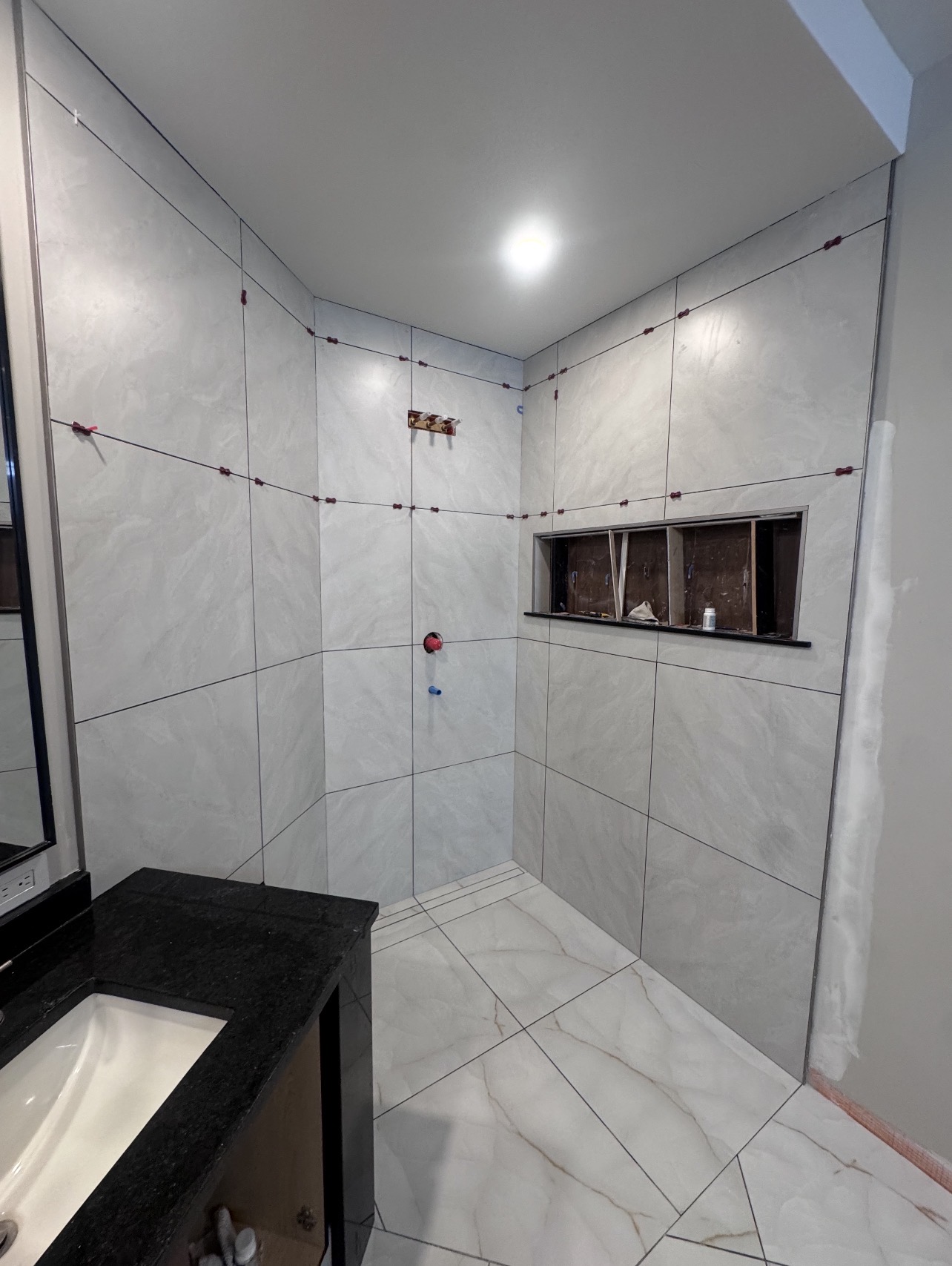
A leaking shower doesn't fail immediately. It fails slowly, invisibly, behind the tile — until it doesn't.
Grout is not waterproof. Water always finds its way through — especially at the floor, at caulk joints that crack, and at grout lines near the shower valve.
Water sits in the substrate — cement board, drywall, or wood framing — causing mould, rot, and structural damage. This process is invisible until the damage is severe.
By the time a failed shower shows visible signs — soft spots, loose tile, visible mould — the entire installation must be demolished and rebuilt from the substrate. The cost is three to five times what a proper job would have been.
Every project in our gallery was completed using the same equipment, the same certified systems, and the same approach described on this page.
Free quotes. Honest timelines. Owner on every job.